Modi’s Elephant in the Room

Modi’s visit to Srinagar Saturday brings to mind an event where in September 2006 the British artist Banksy gave special meaning to the phrase “elephant in the room” in a Los Angeles exhibit called Photo credit: Gary Martin  www.phrases.org.ukBarely Legal. It’s theme was global poverty. As writer Gary Martin says, “By painting the elephant in the same bold pattern as the room’s wallpaper, Banksy emphasized the phrase’s meaning, by both making the elephant even more obvious and by giving those who chose to ignore it (like the woman in the tableau) an opportunity to pretend that it had blended into the wallpaper background.
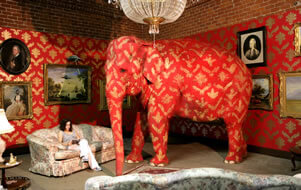
Modi’s elephant in the room was depicted in the same way in Srinagar, the Capitol City of Kashmir this past weekend, where we had the same artificial set re-enacted. The attempt to disguise the true problem of Kashmir by locking up the voices and spirit of resistance to Indian oppression did not make it go away nor did it recede into the wallpaper. The dispute over the sovereignty of the land and people of Kashmir cannot be hidden by all the cosmetics that $12 billion can purchase.

In the carefully choreographed visit, Modi was given a warm welcome by around 15,000 people who included couple of thousand police personnel in plain clothes, a few thousand daily wagers, some non Kashmiri employees who come from the Indian State of Bihar and of course some loyalists of PDP patron, Mufti Mohammad Sayeed.

It was no surprise to the local residents of Srinagar when they found out that the non-Kashmiri (Behari) employees did not show up to work. They had been detoured and corralled into listening to the prime minister who was otherwise going to standing before a lot of empty seats.

The highways were closed for public transportation, restrictions were imposed on movement, drop gates were erected in every nook and corner of the city of Srinagar and cordon and search operations were conducted. Curfew-like restrictions were imposed in Srinagar. Hundreds of leaders of the resistance were detained to prevent them from leading a march which was expected to attract more than a million Kashmiris.

Syed Ali Geelani’s call for ‘Million-Man-March’ was endorsed by all including Mirwaiz Umar Farooq, Mohammad Yasin Malik, Shabir Ahmed Shah and others. It was expected to attract virtually the whole population of the city, towns and villages – men, women and children — to express their desire for a political solution and not the economic package of the Kashmir dispute.

The local papers reported that the daily wagers from various departments of Agriculture, Horticulture, Forest, Fisheries, Labour and Animal Husbandry were ordered to assemble at Town Hall in Pulwama on Friday, November 6, 2105 at 6 pm so that they could be taken to Srinagar to participate in this Bansky-like staging of a rally on Saturday, November 7, 2015.

The local news agency CNS reported, “We (police personnel) have been asked to ensure our presence at our police lines in Pulwama for physical fitness tests but we are sure that we will also be taken to Sher-i-Kashmir Cricket Stadium to attend Modi’s rally,” said an SPO, wishing not to be named.

It has been the tragedy that the Indian leadership not to listen to the saner voices. India’s obduracy has never helped resolve the Kashmir dispute. And Narendra Modi is no different . It is the basic principle of international relations that when the parties are not able to resolve the conflict, then it is always better to listen to saner elements beyond the parties who are directly involved in the conflict, such as U.S. President Harry Truman who was in office when the Kashmir dispute erupted at the United Nations in 1948. Men like President Mandela who said that ‘we should be willing to lend all the strength we have to the resolution of this matter (Kashmir),’ and President Obama who has also said that the resolution of Kashmir is in the interest of the world peace.

Prime Minister Modi should realize that money can certainly solve some of the problems caused by last year’s flood, but it will not remove the ever-present and destabilizing atmosphere of oppression, the violence in the streets, and the persistent trauma of rape, murder and disappearances that have been the hallmark of India’s history in Kashmir.

Mere sloganeering, economic packages and cricket diplomacy will never solve the Kashmir problem. Kashmir is a political issue which needs a political solution. The immediate necessities are the following:

  1. The intervention of the international community to bring the violence in Kashmir to a quick end. This intervention could also be the facilitation of a person of international standing, like Nobel Laureates, Bishop Desmond Tutu or Dr. Kofi Annan;
  2. Demilitarization of the State of Jammu and Kashmir on both sides of the Cease-fire Line;
  3. Initiation of a political dialogue between all parties concerned – India, Pakistan and the leadership of the people of Jammu & Kashmir to set a stage for a democratic and peaceful solution.

Similar Posts

  • Twelfth International Kashmir Conference Concluded in New York

    New York. December 11, 2015. Twelfth International Kashmir Peace Conference, entitled, “Beyond the Blame Game: Finding Common Grounds for Peace and Justice in Kashmir,” organized by International Educational Development (IED) at the Church Center of the United Nations, New York, attended among others by the academics, researchers, the delegates from various United Nations Missions, representatives of the United Nations NGO’s, social and civil rights activists, political analysts and prominent Americans of South Asian origin, began with the key-note speech delivered by Hon. Ramsey Clark, 66th Attorney General of the United States.

  • Kashmiris Demanded UN Pledged Right of Self-Determination

    New York, October 26, 2015. A huge peace march took place in New York in which thousands of friends of Kashmir participated. The march was jointly sponsored by all groups who believe in the right of self-determination of the people of Kashmir.

    The very inspiring March began at the Indian Mission to the UN on 43rd Street and led up 3rd Avenue to 47th, terminating in front of the United Nations. The cooperation of NY state and city police was exemplary, and there were no incidents which marred the event.

    Hundreds also participated in London, Brussels, Islamabad and Muzaffarabad with their own marches. In Srinagar, Kashmir, however, the leadership was put under house arrest in Srinagar so they could not go the office of the UN and present the memorandum.

  • Nuclear Summit reminded that Kashmir was the nuclear flashpoint

    Washington, D.C. March 31, 2016. An impressive peaceful demonstration was held during Nuclear Security Summit in front of the Washington D.C. Convention Center wherein hundreds of participants, who came from New York, New Jersey, Pennsylvania, Delaware, Maryland, Virginia and Washington itself were carrying the placards with the message, “ Kashmir: Nuclear flashpoint”; “Time to resolve the Kashmir dispute is now”; “Freedom for all: Freedom for Kashmir”; “Kashmiris demand right of self-determination”; “India: Stop human rights violations in Kashmir.” “Road to Kabul Runs Through Kashmir.”

    The participants highlighted that Kashmir was at the brink of a potential nuclear holocaust, and this holocaust was occurring because the root cause of independence and freedom for Kashmir had not been adequately addressed. Kashmir has ignited two wars between the estranged South Asian rivals in 1948 and 1965, and a third could trigger nuclear volleys and a nuclear winter threatening the entire globe. The United States would enjoy no sanctuary. Both India and Pakistan are racing like thoroughbreds to bolster their nuclear arsenals and advanced delivery vehicles. Their defense budgets are climbing despite widespread misery amongst their populations.

  • Kashmir: The Pursuit of the Possible

    Benjamin Franklin, a signer of the U.S. Declaration of Independence from Britain, and a man responsible for negotiating a treaty between the colonies and France, asked, “When will mankind be convinced and agree to settle their difficulties by arbitration?”

    Perhaps the simple answer to that is that it will occur when power is distributed among men in such a way that it cannot be abused by any individual or nation, and that both personal and national sovereignty is once and for all respected.

    Benjamin Franklin was a very wise man. He wrote, in respect to the American Revolution, “We have been assured, sir, in the sacred writings, that ‘except the Lord build the house they labor in vain that build it.’ I firmly believe this; and I also believe that without His concurring aid we shall succeed in this political building no better than the builders of Babel; we shall be divided by our little partial, local interests, our projects will be confounded and we ourselves shall become a reproach and a byword down to future ages. And, what is worse, mankind may hereafter, from this unfortunate instance, despair of establishing government by human wisdom and leave it to chance, war, or conquest.”

  • Resolution of Kashmir can Unlock War in Afghanistan

    The idea that the dispute over the status of Jammu and Kashmir can be settled only in accordance with the will of the people, which can be ascertained through the democratic method of a free and impartial plebiscite, was the common ground taken by all the three parties to the dispute, viz., the people of Kashmir, Pakistan, and India. It was supported without any dissent by the United Nations Security Council and prominently championed by the United States, Great Britain, France and other democratic states.

    It became a matter of controversy only after India realized that she could not win the people’s vote. Due to the cold war, she found a firm ally for her obstructionist position in the Soviet Union. With the end of the cold war, the original perspective should have been recovered.

  • Kashmiris can determine their own political destiny: Dr. Fai

    Baltimore, Maryland. May 31, 2016. “The world powers have voiced not a syllable of reproach to India for its human rights violations in Kashmir. Their tacit message to India’s leaders: your economic attractiveness and hegemony in South Asia exculpate your human rights atrocities in Kashmir. Does that reflect a profile in courage?” this was stated by Dr. Ghulam Nabi Fai, Secretary General of World Kashmir Awareness during the 41st Annual Convention of Islamic Circle of North America (ICNA).

    Dr. Fai was speaking in the panel, entitled, “Muslims Around The World Series” on the subject of Kashmir. Other speakers included Dr. Nikibur Rahman, son of Motiur Rahman Nizami who was executed in Bangladesh on May 11, 2016 through a trial procedure that international human rights groups, including ‘Amnesty International’ have condemned as deeply flawed. ‘The Arab Spring: 6 Years later’ was presented by Dr. Abdul Mawgoud Dardery, former Member of Parliament of Egypt.