
Nuclear Summit reminded that Kashmir was the nuclear flashpoint
Washington, D.C. March 31, 2016. An impressive peaceful demonstration was held during Nuclear Security Summit in front of the Washington D.C. Convention Center wherein hundreds of participants, who came from New York, New Jersey, Pennsylvania, Delaware, Maryland, Virginia and Washington itself were carrying the placards with the message, “ Kashmir: Nuclear flashpoint”; “Time to resolve the Kashmir dispute is now”; “Freedom for all: Freedom for Kashmir”; “Kashmiris demand right of self-determination”; “India: Stop human rights violations in Kashmir.” “Road to Kabul Runs Through Kashmir.”
The participants highlighted that Kashmir was at the brink of a potential nuclear holocaust, and this holocaust was occurring because the root cause of independence and freedom for Kashmir had not been adequately addressed. Kashmir has ignited two wars between the estranged South Asian rivals in 1948 and 1965, and a third could trigger nuclear volleys and a nuclear winter threatening the entire globe. The United States would enjoy no sanctuary. Both India and Pakistan are racing like thoroughbreds to bolster their nuclear arsenals and advanced delivery vehicles. Their defense budgets are climbing despite widespread misery amongst their populations.
“All those leaders attending the Nuclear Summit and those who are interested in the world peace are urged to persuade both India and Pakistan to help resolve the Kashmir dispute for the sake of international peace and security,” said Dr. Ghulam Nabi Fai, Secretary General, World Kashmir Awareness.
Dr. Imtiaz Khan, President, Kashmiri American Council said that Kashmir was the bone of contention of nuclear tension between India and Pakistan. The world powers must impress upon the Government of India to stop human rights violation in Kashmir.
Sardar Sawar Khan, former Advisor to the Prime Minister of Azad Kashmir said that Kashmir was a nuclear flashpoint. Kashmir was called the most dangerous place in the world by former President Bill Clinton.
Sardar Imtiaz Khan, New Jersey quoted President Vladimir Putin who said, “India and Pakistan should resolve Kashmir dispute in the interest of peace in South Asia and the rest of the world.”
Choudhary Zahoor Ahmed reminded President Obama of his promise that he made in 2008 when he said, “I will continue support of ongoing Indian Pakistani efforts to resolve Kashmir problem.”
Sardar Imtiaz Garalvi cited the example of torture, rape, mass murder and disregard for the U.N. resolution for a referendum on Kashmir by the Government of India.
Sahibzada Imtiaz Zafar said that the peaceful demonstration was an honest and sincere reflection of the wishes of the people of Kashmir.
Chand Iqbal Doddy said that Pakistani and Indian leaders must sit down with the Kashmiri leadership to discuss the future of Kashmir.
Sardar Zarif Khan said that we accept that solution which respects the wishes of the people of Kashmir.
Sardar Taj Khan said the fact that political solutions had been achieved in Namibia and East Timor which gave the hope and confidence to the people of Kashmir.
Sardar Zulfiqar Khan and Sardar Zubair Khan thanked the participants for making the occasion a success.
Sardar Zahid Hussain was the stage secretary of the event. He concluded the event by offering prayers to all those innocent civilians who gave their today for the betterment of tomorrow.
Other people who spoke during the occasion include:
- Mohammad Sabir;
Sufi M. Nazir;
Sardar Ajmal Khan;
Raja Liaqat Kiyani
 “Kashmir Million-Man-March is being organized on October 25 in New York to pave a way for a just and durable resolution of longstanding Kashmir dispute.” Addressing a huge gathering of friends of Kashmir in Keansburg, New Jersey, he said the world community was concerned about the latest situation in Kashmir which can lead the whole region of South Asia to the nuclear disaster. The world powers including the United States are trying to persuade both India and Pakistan to resume the peaceful negotiation to settle all disputes including the dispute over Kashmir.
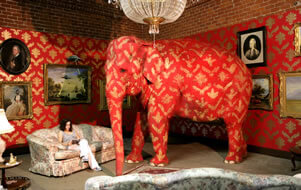 Barely Legal. It’s theme was global poverty. As writer Gary Martin says, “By painting the elephant in the same bold pattern as the room’s wallpaper, Banksy emphasized the phrase’s meaning, by both making the elephant even more obvious and by giving those who chose to ignore it (like the woman in the tableau) an opportunity to pretend that it had blended into the wallpaper background.“