
While India Celebrates, Kashmir Mourns
N.N. Vohra, Governor of Jammu and Kashmir and apparent ventriloquist dummy for some folks a little further south, according to Kashmir Today, “observed that it is the duty of all citizens to protect and preserve the unity and integrity of the nation, adding that towards the attainment of such an objective all of us must join hands to negate all divisive and communal forces and promote societal harmony and brotherhood.”
India is of course celebrating its 67th Republic Day to honor its Constitution that became enforceable on January 26 in 1950. But the world’s largest “democracy” had no such democratic intentions for Kashmir. It was just two years earlier that the United Nations Security Council had been adopted, creating the Ceasefire Line, which was to end the war, stave off further conflict between India and Pakistan and pave the way for conditions in which a plebiscite could be held in which the people of Jammu and Kashmir could decide for themselves whether they wished to be an integral part of India, join Pakistan, or be free to chart their own course as an independent state.
Vohra’s comments sound like nice words, sort of like you might have heard in the sixties in the West’s hippie movement, with the Beatles crooning, “All You Need Is Love.” Perhaps we should all go out and pick flowers and do some of that funny stuff. But in a community where such a speech is accompanied by tightened security measures with drones flying overhead and heavily armed men and vehicles have shut off all access, it’s hardly reminiscent of a lovefest in Berkeley, nor does it reflect the spirit in which a constitution creating democratic process in the Republic of India would otherwise exhibit. One thinks more of the Bob Dylan song written during that era and made popular by Peter, Paul and Mary, “Blowing In the Wind,” with the lyrics, “How many roads must a man walk down before you call him a man?” How many roads must Kashmiris walk, it must be asked, before they are given their independence?
The subsequent unilateral actions of India in refusing to permit a plebiscite and declaring then that Jammu and Kashmir and all its people were the property of the state has since defined the conflict between India and Pakistan and led to hundreds of thousands of deaths. For what reason?
India certainly has the right to celebrate this historic day within its legal boundary. But according to all recognized UN resolutions and other policies adopted by foreign states, Kashmir remains a disputed territory. Therefore, India persists in allying itself with a position that has no legal, moral or constitutional authority to celebrate the Republic Day in Kashmir which is not the integral part of its territory. Its advocacy of this is no doubt the prime cause of continued suffering in Kashmir and persistent violations at the Ceasefire Line, sustaining the potential for more all-out war between the two countries.
All available evidence shows that India has occupied the territory with its military might on October 27, 1947 and that horrendous act took place against the wishes and will of the people of Jammu & Kashmir. Hari Singh, the Maharaja, of course fled the Valley immediately following this crime, raising obvious questions as the legitimacy of his authority as a representative and spokesperson for the country he supposedly handed over to this undemocratic democracy. For Kashmiris, this is not a day to celebrate but a day of mourning, a day of catastrophe, when their power of self-determination was taken from them by occupiers.
India claims to be the largest democracy. The impartial and neutral agencies of the world testify that when it comes to Kashmir, India is nothing but an occupier. To quote Bertrand Russell, “The high idealism of the Indian government in international matters breaks down completely when confronted with the question of Kashmir.”
India violates the basic right to the people of Kashmir, like freedom of speech, freedom of opinion, freedom of travel, freedom of assembly and above all freedom to choose their destiny to be a part of India or Pakistan or remain independent. But that freedom to choose has to take place in an atmosphere that is free from coercion, intimidation and the military occupation by 700,000 Indian military and paramilitary forces who pillage and kill at will.
Mahatma Gandhi has said that Kashmir’s real rulers were its people and not its Maharajas. “If the people of Kashmir are in favor of opting for Pakistan, no power on earth can stop them from doing so. But they should be left free to decide for themselves.” (Gandhi’s Passion by Professor Stanley Wolpert, Page 247)
It will be better if India accepts the ground realities that the resolution of Kashmir will guarantee peace and stability not only in India and Pakistan but also in the whole region of South Asia and beyond. But that resolution needs to be explored by all parties concerned _ Governments of India & Pakistan and the leadership of the people of Jammu & Kashmir.
 “Kashmir Million-Man-March is being organized on October 25 in New York to pave a way for a just and durable resolution of longstanding Kashmir dispute.” Addressing a huge gathering of friends of Kashmir in Keansburg, New Jersey, he said the world community was concerned about the latest situation in Kashmir which can lead the whole region of South Asia to the nuclear disaster. The world powers including the United States are trying to persuade both India and Pakistan to resume the peaceful negotiation to settle all disputes including the dispute over Kashmir.
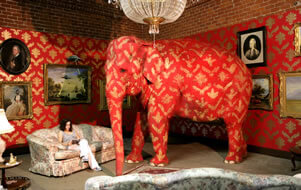 Barely Legal. It’s theme was global poverty. As writer Gary Martin says, “By painting the elephant in the same bold pattern as the room’s wallpaper, Banksy emphasized the phrase’s meaning, by both making the elephant even more obvious and by giving those who chose to ignore it (like the woman in the tableau) an opportunity to pretend that it had blended into the wallpaper background.“