
Kashmir and the Nuclear Threat
“The best way to solve any problem is to remove its cause.” Martin Luther King
“Nuclear weapons are the scourge of the earth; to mine for them, manufacture them, deploy them, use them, is a curse against God, the human family, and the earth itself.” Philip Berrigan, American Peace Activist.
The nuclear age has placed in the world’s lap a growing and complex set of threats that create the possibility of an all-out holocaust in some part of the world almost every day. We now have North Korea threatening Seoul, testing intercontinental ballistic missiles and bragging about hydrogen bombs. Few people know that the Korean War has never ended. The Armistice Agreement was just a ceasefire. No formal treaty was ever signed. Then there’s NATO playing war games at Russia’s borders, with generals talking about taking back Crimea. And let’s not forget Israeli Prime Minister Netanyahu who has threatened to attack Iran unilaterally if no one else does it. But in South Asia, the mainstream media seems to overlook frequently a continuous and ongoing threat of another kind.
Let’s get a quick snapshot of the problem: If you had half a dozen soldiers from a foreign country stalking your neighborhood block day and night, watching your every move, noting when you come and go, who your children are playing with, and who you talk to in your neighborhood, how would you feel? People worry about the National Security Agency (NSA) and global spying, but this is in another league entirely.
What would you think if occasionally you would see these soldiers arrest one of your neighbors and then go into his house, ransack it and dishonor his wife? What’s your take if another neighbor came out and complained to the soldiers and they simply shot him on the spot, labeling him a threat under the Armed Forces Special Powers Act, which is nothing more than a license to kill?
What would you say if the wife then went to the authorities looking for her husband’s whereabouts and they allege no knowledge of holding him or his arrest, and he never returns home again? There are thousands of women like this now in Kashmir. They are called “half widows.” No death certificate has been issued. No one can prove that the husband is dead. And therefore they are without the help of the legal system and social agencies and condemned to a cruel limbo.
What then would be your response if the man’s son, seeing all this take place, is so angered that he picks up stones and hurls them at the soldiers’ vehicles, and he too is arrested and disappears in a similar fashion? Stone pelters, as they are called, have also become a fixture on the streets of Srinagar. There is a resistance smoldering beneath the surface of this occupation that belies every notion that India is actually in control and managing its colonial possession.
This is Kashmir. This kind of thing isn’t an occasional incident that happens once every six months or even once a month. This is daily life in India-occupied Kashmir.
Kashmir currently has more than 700,000 military and paramilitary troops occupying a country with no more than 12.5 million people, a ratio of one soldier for every 17 citizens. However, because of their concentration in the towns and cities, the density is more like 10 to one. Imagine what that would be like on your city block.
Having so many troops in this small country whose size is no greater in square miles than the U.S. state of Tennessee should certainly be a cause for concern by anyone. Why are they there? Where’s the war? Is neighboring Pakistan about to invade? Is China? Do they have a similar amount of troops amassing at the border? Has ISIS invaded Kashmir with terrorists hiding in every house? This is more than three times the number of troops the U.S. had at the height of the Iraq War.
The answer is None of the Above. It’s a curious fact that we have a very circular problem inherent in a deep paranoia India has long had of an uprising and its use of such troops to maintain control and put down any threat has become a way of life. It’s like avoiding a fire by burning down the house first.
The possibility of such an uprising is greatly enhanced and exacerbated by the presence of these troops and would more likely be a direct provocation for such an uprising and in fact has been. Rather than relieve the pressure in the cooker by taking it off the fire, India’s solution has been to simply turn up the burner. The greatest cause of discontent is this constant abrasive to the social conscience, this erosion of trust for government, whether local elected leaders or those non-resident landlords in New Delhi, and a pervasive atmosphere of fear. People look for leadership elsewhere, and they have. There is a deeply entrenched movement at the grassroots level that has become very influential in being the voice of public opinion. ,
Rather than admit that they have a problem, India blames Pakistan for any little flare-up, suggesting that the incident has been provoked by Pakistani terrorists. Gautum Navlakha, former Editor of Economic and Political Weekly of India said the same thing, “Long and short of it is that Indian state has become its own worst enemy. There is no point blaming Pakistan, fundamentalists, human rights activists and the usual alibis used by the Indian state. It is time to acknowledge that ‘national security’ paranoia cannot hide the reality that Muslims of J&K have no confidence in the Indian state.”
However, the deeper problem is in history, native born, and the cry of “azadi” which has been torn from the hearts of Kashmiris from the time of British occupation prior to 1947 and the anger, distrust and a deep sense of betrayal in seeing India take control and occupy Kashmir when the British withdrew. They had been promised a plebiscite by Pandit Jawaharlal Nehru, Prime Minister of India, in a broadcast from New Delhi on 2 November 1947, who said:
“We have declared that the fate of Kashmir is ultimately to be decided by the people. That pledge we have given, and the Maharaja has supported it, not only to the people of Kashmir but to the world. We will not, and cannot back out of it. We are prepared when peace and law and order have been established to have a referendum held under international auspices like the United Nations. We want it to be a fair and just reference to the people, and we shall accept their verdict. I can imagine no fairer and juster offer.”
UN Security Council Resolution # 47 reaffirmed that. .But India would not then and will not now honor that commitment or admit that its claim to Kashmir is illegitimate. And it will not admit to the world that the Kashmiri people are fighting mad, still, after almost 70 years of false hope. Perhaps India believes that if it keeps repeating the same lie over and over again, that Kashmir is an integral part of India and that Pakistan is simply stirring up trouble, things will settle down if a few carrots are offered, and the problem will go away.
Unfortunately it’s been mostly stick and little carrot. The presence of the troops is as much a contributor to ideas of revolt as they are any kind of restraint against an uprising. The cry for azadi (Freedom) has simply gotten louder. As such the level of tensions between India and Kashmir and between India and Pakistan show few signs of letting up any time soon. It has been consistently a witch’s brew that has done nothing but engender evil throughout the whole region.
India continues to blame Pakistan for the unrest in Kashmir. It is a convenient excuse to ignore the people’s demands for self-determination. But ignoring the decades old problem of refusing to resolve the question of Kashmiri sovereignty and self-determination has not only led to deep unrest among the Kashmiris; it has also led to two wars between India and Pakistan. That they are now both nuclear-armed states raises the stakes dramatically and calls for action to defuse these tensions immediately.
There will be a nuclear summit in Washington on March 31st and April 1st when 40 heads of state including India and Pakistan will participate. The delegations of India and Pakistan will have an opportunity to meet on March 31st in Washington. We hope that they will have more to discuss than cricket.
Perhaps not by coincidence, the danger of nuclear threat will be of paramount interest. Kashmir has been regarded by Bill Clinton as the most dangerous place on earth. Former Prime Minister of New Zealand, Helen Clark said, “Kashmir is a nuclear flashpoint.” It is clearly the bone of contention of nuclear confrontation between India and Pakistan. Kashmir is the only nation in the world which is surrounded by three nuclear powers – India, Pakistan & China. As President Obama said on November 10, 2010 in New Delhi, the resolution of Kashmir is in the interest of India, Pakistan and the region and the United States.
Perhaps it’s time the major powers take this seriously. The answer is plain as day for anyone. Kashmir has international legitimacy, having numerous UN Security Council resolutions which have given the right to self-determination to the people to decide their destiny. They should once and for all be honored. The clock is ticking. Every day that passes without resolution of Kashmir dispute is one day closer to a cataclysm that will reach far beyond the borders of all countries involved.
 “Kashmir Million-Man-March is being organized on October 25 in New York to pave a way for a just and durable resolution of longstanding Kashmir dispute.” Addressing a huge gathering of friends of Kashmir in Keansburg, New Jersey, he said the world community was concerned about the latest situation in Kashmir which can lead the whole region of South Asia to the nuclear disaster. The world powers including the United States are trying to persuade both India and Pakistan to resume the peaceful negotiation to settle all disputes including the dispute over Kashmir.
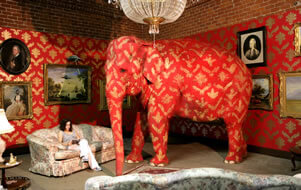 Barely Legal. It’s theme was global poverty. As writer Gary Martin says, “By painting the elephant in the same bold pattern as the room’s wallpaper, Banksy emphasized the phrase’s meaning, by both making the elephant even more obvious and by giving those who chose to ignore it (like the woman in the tableau) an opportunity to pretend that it had blended into the wallpaper background.“